
Agentic Workflows: A Practical Multi-Agent Orchestration Guide
Here is something most people still do not fully grasp. Every time we ask an AI to research competitors, generate a full campaign brief, write and iterate video scripts, or qualify leads across multiple channels, we are usually forcing a single model to do everything in one long, fragile chain of prompts. The results are often uneven. Context gets lost. Tool calls fail. Multi step work collapses halfway through. And the cost keeps climbing because we keep throwing larger models at problems that actually need better coordination, not just more parameters.
The numbers tell the story clearly. Nearly eight in ten companies now report using generative AI, yet the majority still see no significant bottom line impact. Gartner projects that by the end of 2026, 40 percent of enterprise applications will include task specific AI agents up from under 5 percent just one year earlier. At the same time, only about 11 to 14 percent of agentic AI use cases have reached true production. The gap between experimentation and reliable, multi step execution is the defining challenge of 2026.
A clear solution is emerging: agentic workflows and orchestration. Instead of one model trying to do everything, we design systems of specialized agents that plan, use tools, hand off work, run in parallel, and check each other’s output. Anthropic’s production research system built on an orchestrator worker pattern outperformed a single powerful agent by 90.2 percent on complex breadth first research tasks. Parallel sub agents cut research time by up to 90 percent on the hardest queries. This is not incremental. It is a structural shift from “ask a smart chatbot” to “deploy a coordinated digital team.”
This article breaks down what agentic workflows actually are, the hard numbers behind the performance gains, the leading orchestration patterns and frameworks, and most importantly what this means for how we design AI features and internal systems at Digital Portal Official.
What Is an Agentic Workflow?
An AI agent is a software system that uses a model to choose actions toward a goal. Depending on its design, it may search for information, call an API, read a file, update a record, inspect a result and decide what to do next.
An agentic workflow connects these actions to an explicit process. It defines:
- Which tools the system may use
- What information moves between steps
- When a step should be retried or stopped
- How outputs are validated
- When a person must review or approve the work
Multi-agent orchestration is one type of agentic workflow. Instead of relying on one agent, an orchestrator assigns parts of a task to specialist agents and combines their outputs. The orchestration layer controls routing, sequence, shared workflow state, permissions and escalation.
This is different from assigning several AI personas and asking them to discuss a problem. A production system needs clear contracts: what each component receives, what it may do, what it must return and how failures are handled.

Why Long, Single-Agent Workflows Often Break Down
Many business requests are not simply writing tasks. They are processes with dependencies.Consider a campaign brief for a local service in Bahria Town or DHA. The work might require researching named competitors, verifying their services and positioning, identifying audience segments, developing creative concepts, drafting advertisements and preparing a client-ready summary.
The process also involves brand requirements, source quality and approval before anything is published or funded.One AI model can attempt the entire job, but a long, uninterrupted run introduces several risks. Early instructions may lose influence as the context grows. Weak research can affect every later deliverable. Tool errors may be overlooked, while identifying the stage responsible for a poor result becomes difficult.Re-running the entire task can also waste time and tokens.
These problems do not automatically justify multiple agents. A structured single-agent workflow with validation may be enough. Multi-agent orchestration becomes more useful when a task contains independent branches, requires different tools or involves more information than one agent can manage cleanly.
What Does the Evidence Show?
Public evidence supports a focused conclusion: multi-agent systems can perform well on tasks suited to parallel exploration, but the improvement comes with additional cost and does not apply equally to every type of work.
In 2025, Anthropic reported that its orchestrator-worker research system outperformed a single-agent Claude Opus 4 setup by 90.2% on an internal breadth-first research evaluation. Its system used a lead agent to plan the research and delegate separate lines of investigation to sub-agents with independent context windows.That result should not be treated as a general performance guarantee. It came from a particular system, model configuration and research task.
Anthropic also reported that its agents typically used about four times as many tokens as ordinary chat interactions, while multi-agent systems used about 15 times as many. The company identified heavily parallel, information-intensive and tool-dependent tasks as strong candidates for multi-agent architecture. Work with tightly connected dependencies may be less suitable. These findings are documented in Anthropic’s engineering report on its multi-agent research system.
Enterprise surveys show a similar gap between experimentation and measurable value. McKinsey’s 2025 global survey found that 88% of respondents reported regular AI use in at least one business function, but only 39% reported any enterprise-level EBIT impact. Camunda’s 2026 research, based on responses from 1,150 senior IT leaders, business decision-makers and enterprise software architects, reported that 71% of participating organizations used AI agents. Only 11% of agentic use cases had reached production during the previous year.
These surveys use different samples and definitions, so their results should not be combined as if they measure the same population. Together, however, they indicate that experimenting with AI is easier than turning it into a dependable production process.Industry forecasts also require context. Gartner projected that up to 40% of enterprise applications would contain task-specific agents by the end of 2026. It separately predicted that more than 40% of agentic AI projects would be cancelled by the end of 2027 because of rising costs, unclear business value or inadequate risk controls.
These are analyst forecasts, not confirmed outcomes. They reinforce the need to choose use cases carefully and measure results instead of assuming that adoption alone creates value.
Which Multi-Agent Orchestration Pattern Should You Use?
The right pattern depends on the structure of the task. It should not be chosen merely because a framework makes it easy to demonstrate.
| Pattern | How It Works | Suitable Uses | Main Risk |
|---|---|---|---|
| Sequential Workflow | Each stage passes a defined output to the next. | Lead intake, qualification, brief creation and approval. | Early errors can spread downstream. |
| Handoff | A router transfers control to one relevant specialist. | Support triage or routing requests by service. | Poor routing or missing context. |
| Concurrent Plus Synthesis | Independent agents explore separate branches before their findings are merged. | Competitor research and evidence gathering. | Duplicate work or conflicting findings. |
| Orchestrator-Worker | A lead agent divides a broad task and directs specialist workers. | Open-ended research and complex planning. | Higher token use and difficult debugging. |
| Maker-Checker | One component creates an output and another checks it against defined criteria. | Source checks, brand review and quality assurance. | The checker may repeat the creator’s blind spots. |
Strong systems often combine these patterns.A campaign workflow, for example, could use a sequential backbone, parallel competitor-research agents and a human approval stage before any creative material reaches a client.
When Should Digital Portal Use Multiple Agents?
Multi-agent orchestration is most appropriate when several of the following conditions apply:
- The outcome has enough business value to justify additional cost and engineering
- The task can be divided into independent or lightly connected parts
- Different stages require different tools, instructions or permissions
- Parallel work can reduce delivery time or improve coverage
- Outputs can be checked against clear acceptance criteria
- Failures can be contained before anything is published or changed
- The workflow occurs often enough to justify building and maintaining it
Competitor research may meet these conditions because separate workers can investigate different companies or evidence categories. Writing a short social media caption usually does not.
When Is a Simpler System Better?
Use deterministic automation when the steps and rules are already known. Use retrieval when the main requirement is finding and summarizing approved information. Use one model with a limited set of tools when the task is coherent and its output is easy to validate.
Multi-agent orchestration is usually unnecessary when:
- The work depends heavily on one shared context
- A rule or API call can complete the task reliably
- The task is low-value or extremely frequent
- Correctness cannot be measured
- The agents would need broad permissions
- Most of the work must be reviewed or redone by a person
Additional complexity should have a measurable reason to exist.
A Practical Agentic Architecture for Digital Portal
Digital Portal does not need to begin with a fully autonomous platform. A layered architecture can introduce useful automation while keeping responsibilities and permissions clear.
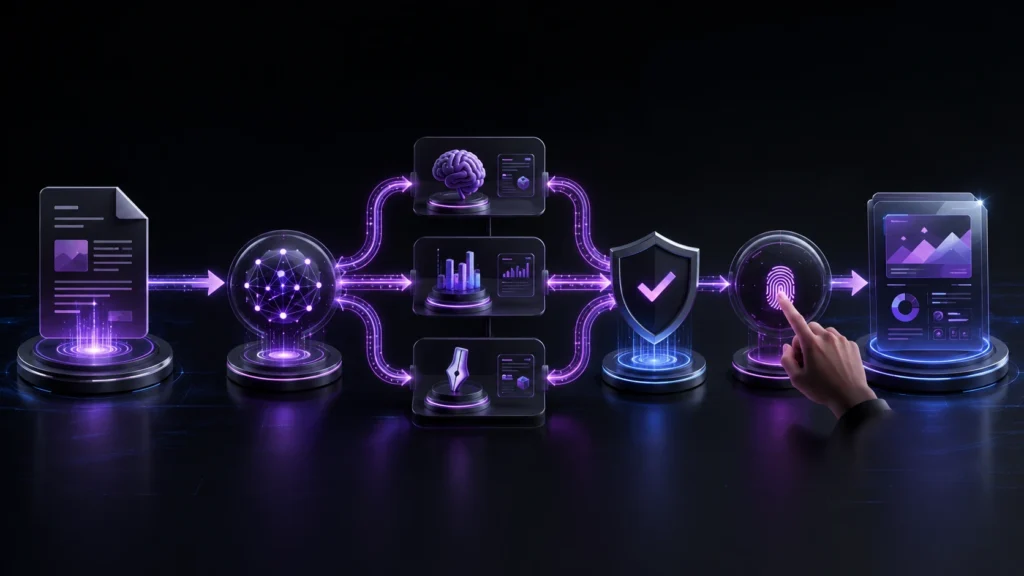
Intake and Routing
A lightweight router can classify each request, confirm that required information is present and send it to an approved workflow.Requests with missing information should pause for clarification instead of allowing the system to guess. The router should select from a controlled catalogue, such as campaign research, SEO audit, lead qualification or support triage.It should not create unrestricted workflows automatically.
Workflow State and Evidence
Every run needs a durable record containing:
- The original brief
- Approved inputs
- Current workflow stage
- Tool results and sources
- Validation outcomes
- Decisions and approvals
- Errors and retries
Each agent should receive only the information needed for its role.A structured workflow record is more useful than a long conversation transcript. It makes interrupted work easier to resume and failed runs easier to investigate.
Specialist Components
Specialist agents should have narrow responsibilities and measurable outputs. A campaign workflow might include a source-backed research agent, a strategy drafter and a brand-policy checker. An SEO workflow could separate technical inspection from content analysis. Specialization should come from tools, permissions, data access, instructions and acceptance criteria—not merely from giving agents different job titles.
Validation and Human Approval
Programmatic checks should catch missing fields, broken links, unsupported statements, invalid formats and duplicate records before a person reviews the output.
Human approval should remain mandatory for:
- Client-facing creative work
- Advertising budgets
- Campaign launches
- Public publishing
- Sensitive lead decisions
- Medical or healthcare-related material
- Actions that change important client records
An agent may prepare an action, but preparation is not permission to execute it.
Model and Cost Routing
Not every stage needs the most capable or expensive model.Classification, extraction and format validation may work with a smaller model. Ambiguous strategy, complex reasoning or final synthesis may require a more capable one.
The useful metric is cost per accepted workflow—not cost per individual model call. A cheap call that creates substantial rework is not genuinely cheap. A more expensive synthesis step may be worthwhile if it consistently reduces senior review time.
Where Should Digital Portal Start?
A read-only, evidence-heavy workflow with a clear human deliverable is the safest starting point.
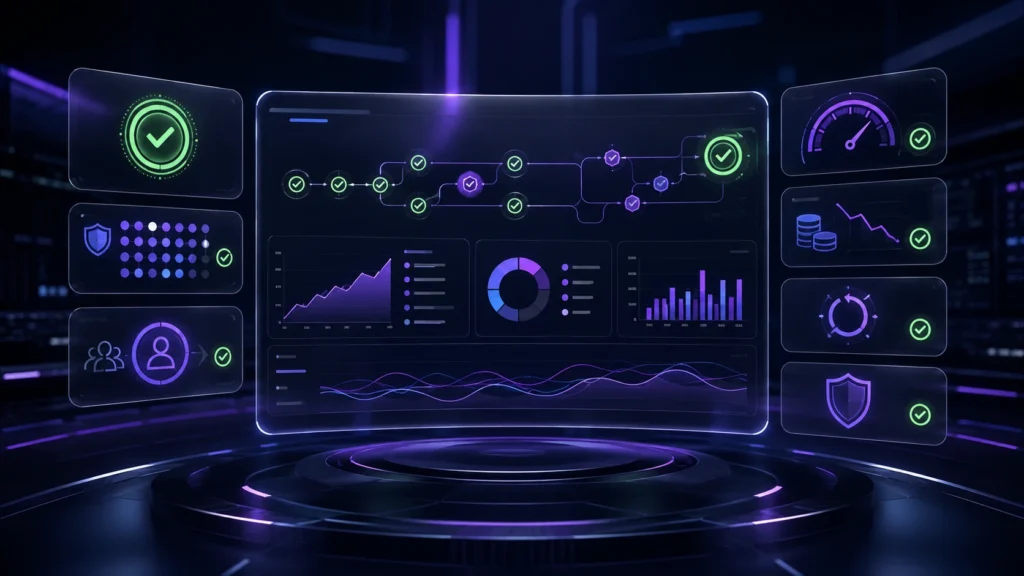
Competitor research for a campaign is a better first pilot than autonomous advertising, public publishing or CRM updates. The research can be divided into separate branches, checked against sources and reviewed before it influences an external action.
A Suggested Pilot Process
- Define one narrow request, such as comparing three named competitors using approved public sources.
- Record the performance of the current manual or single-agent process.
- Divide the work only where genuine parallelism exists.
- Require every material claim to include its source and retrieval date.
- Check for missing information, repeated findings and unsupported statements.
- Ask a human strategist to approve or reject the final brief.
- Compare quality, delivery time, review effort, failure rate and total cost with the original process.
The pilot should be repeated across enough cases to reveal normal variations and common failures. One impressive demonstration is not evidence of production reliability.
How Should an Agentic Workflow Be Measured?
Agentic workflows should be evaluated by completed outcomes rather than fluent responses or the number of tasks they appear to perform.
Useful metrics include:
- Task success rate against a written acceptance standard
- Percentage of material claims supported by acceptable sources
- Human approval and rejection rates
- Average amount of manual correction required
- End-to-end completion time
- Cost per accepted output
- Tool-call and workflow failure rates
- Recovery rate after interrupted steps
- Privacy, security or policy incidents
Client-specific outcome measures may also be useful. However, campaign, sales or revenue changes should not be attributed to an agentic workflow without a credible comparison method.
How Should Frameworks and Protocols Be Evaluated?
LangGraph, CrewAI, Microsoft’s agent tooling, OpenAI’s Agents SDK and Camunda can support different orchestration patterns. Their capabilities change quickly, so no framework should be treated as the permanent best choice for every organization.
Digital Portal should evaluate frameworks against practical requirements:
- Durable workflow state
- Retries and failure recovery
- Human approval support
- Access controls
- Testing and evaluation
- Monitoring and traceability
- Deployment requirements
- Data-handling controls
- Portability
- Team experience
A process orchestration platform may suit governed work across several business systems. A graph-based framework may suit flexible, model-driven workflows. A small custom workflow may be sufficient for an early pilot. Model Context Protocol, commonly known as MCP, standardizes how AI applications connect to tools and data sources. Agent2Agent, or A2A, supports communication between independent agents. These protocols may reduce custom integration work, but they do not provide governance automatically. Identity, permissions, approval and data handling still require deliberate design.
What Are the Main Risks?
Compounding Errors
An unsupported research claim can become a confident strategy recommendation several stages later.Important inputs should be validated before downstream agents use them. Source information should remain attached to the claims it supports.
Excessive Permissions
Each agent should have the minimum access required for its task. Reading, drafting and execution should be treated as separate permission levels.Actions involving money, publication or sensitive records should require explicit approval.
Runaway Costs and Delays
Every workflow should have limits for model usage, tool calls, retries and total run time. The process should stop or escalate when it exceeds those limits.
Weak Monitoring
Teams should be able to review inputs, outputs, tool calls, validation results and approval decisions while respecting client privacy.Without this record, failures are difficult to reproduce, explain or improve.
Sensitive Client Data
Data should be classified before it is sent to any model or external tool. Personal, advertising and healthcare information may require stricter controls than general marketing content.Contractual obligations, platform policies and applicable privacy requirements should be reviewed before deployment.
Conclusion
Digital Portal should approach agentic workflows as process engineering, not as a collection of clever prompts. The best starting point is one valuable, read-only workflow with narrow responsibilities, attached evidence, measurable outcomes and human approval.Multi-agent orchestration can be powerful for parallel, tool-heavy work. It can also become an expensive distraction when a simpler system would work. The real advantage lies in choosing the right architecture, controlling its risks and improving it with evidence.
References
- Anthropic Engineering, “How we built our multi-agent research system” — 90.2% performance improvement and orchestrator-worker architecture: https://www.anthropic.com/engineering/multi-agent-research-system
- Deloitte Insights, “AI agent orchestration” predictions 2026 — market sizing and enterprise guidance: https://www.deloitte.com/us/en/insights/industry/technology/technology-media-and-telecom-predictions/2026/ai-agent-orchestration.html
- AlphaCorp / production pattern ranking, “What Is AI Agent Orchestration? 7 Patterns Ranked for Production (2026)”: https://alphacorp.ai/blog/what-is-ai-agent-orchestration-7-patterns-ranked-for-production-2026
- McKinsey, “Seizing the agentic AI advantage” — gen AI paradox and agentic architecture guidance: https://www.mckinsey.com/capabilities/quantumblack/our-insights/seizing-the-agentic-ai-advantage
- Camunda, “State of Agentic Orchestration and Automation 2026” — production gap statistics (71% using agents, ~11% in production): https://camunda.com/agentic-orchestration/
- Gartner (via multiple industry reports) — 40% of enterprise applications expected to include task-specific AI agents by end of 2026.
- MarketsandMarkets / Deloitte / industry consensus — Autonomous AI agent market trajectory from ~$7–8.5B (2025–2026) toward $35–50B by 2030.
- Framework documentation and production comparisons (LangGraph, CrewAI, Microsoft Agent Framework, OpenAI Agents SDK) — 2026 technical analyses.