
AI Website Technology Is Changing the Digital Landscape
Artificial intelligence is changing how businesses approach technology, marketing, and their digital presence. Tasks that once required separate teams for research, design, development, content creation, and analysis can now be supported by AI tools. For businesses of different sizes, this has created new opportunities to work faster, experiment with ideas, and improve digital processes without relying entirely on traditional workflows.
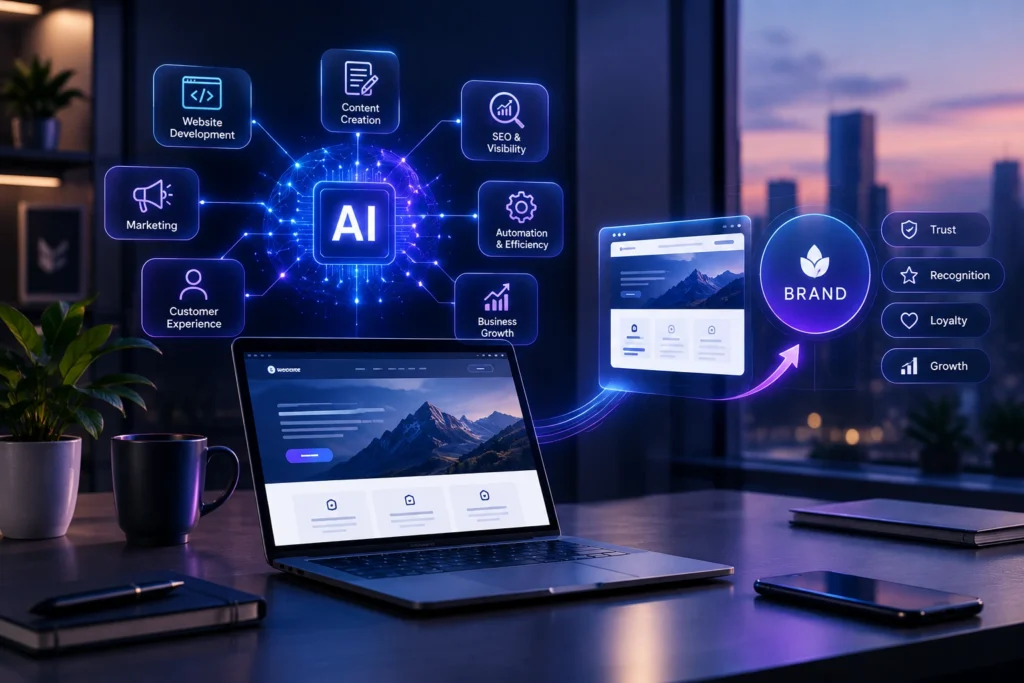
Website development is one of the areas experiencing this shift most visibly. An AI website can be planned and developed with assistance from artificial intelligence, while AI tools can also help generate content ideas, improve user experiences, analyze information, and support ongoing optimization. What once seemed like a highly technical process is becoming more accessible to businesses and individuals.
However, greater accessibility also creates an important question. If AI can help almost anyone create a professional-looking website, what will make one business stand out from another?
The answer goes beyond technology. A website can establish an online presence, but a brand is built through strategy, creativity, consistency, customer experience, and a clear understanding of what a business wants to represent.
A Website Is Not the Same as a Brand
A website is one of the most visible parts of a company’s digital presence, but it should not be confused with the brand itself. A website provides the platform through which customers discover information, explore services, interact with a business, and sometimes make purchasing decisions. A brand, however, represents the perception people develop through those interactions.
Consider two businesses offering similar products or services. Both may have modern websites, professional photography, well-written content, and a strong technical foundation. Yet customers may feel more confident about one company than the other. That difference can come from positioning, communication, reputation, customer experience, and the consistency of the company’s identity.
This is where the limitations of an AI website become clear. AI can help create the structure and many of the elements that appear on a website, but it does not automatically understand the deeper reasons behind a company’s existence. It needs direction from people who understand the business, its customers, its market, and its long-term goals.
A strong brand gives customers something to remember. It creates familiarity and helps a company develop a recognizable identity in an increasingly crowded digital environment.
7 Ways an AI Website Can Support Your Brand
AI should not be viewed simply as a faster way to produce digital assets. When used strategically, it can become a valuable part of the wider process of building and growing a business online.
1. Faster Website Planning and Research
One of the most practical benefits of AI is its ability to accelerate the early stages of a website project. Businesses can use AI to explore potential page structures, organize information, brainstorm content ideas, and think through different customer journeys.
This can make the planning process more efficient, particularly for businesses that are unsure how to translate their goals into a digital experience. Instead of beginning with a completely blank page, teams can use AI to explore different possibilities before refining the direction.
The important part is that these suggestions should be evaluated against real business objectives. A website structure should ultimately make sense for the people who will use it, not simply follow whatever structure an AI tool happens to recommend.
2. More Efficient Content Creation
Content plays an important role in both branding and digital visibility. Website pages, articles, service descriptions, guides, and other resources help businesses explain what they offer and demonstrate their knowledge.
AI can make the content development process more efficient by helping with research, outlines, brainstorming, editing, and early drafts. This can be particularly useful for teams that need to produce content consistently but have limited time.
However, efficiency should not come at the expense of originality. Content that simply repeats information already available across the internet is unlikely to give customers a strong reason to remember a business. Human expertise, real examples, original insights, and a distinct brand voice are what turn basic AI assistance into meaningful content.
Internal link placement: Link SEO and content strategy to your relevant DPO SEO/content service section.
3. Better User Experiences
A good website should make it easy for visitors to find information and understand what a business offers. AI can support this experience through conversational tools, intelligent recommendations, automated assistance, and personalized interactions.
For example, an AI-powered assistant may help a visitor understand which service is relevant to their needs without requiring them to search through multiple pages. In other situations, AI can help businesses analyze user behavior and identify areas where the customer journey could be improved.
The technology itself, however, is not the objective. An AI feature should have a clear purpose and solve a genuine problem. Adding automation simply because it is available can make a website more complicated rather than more useful.
4. More Efficient Website Development
AI-assisted development is also changing the way websites and software are built. Developers can use AI to assist with repetitive coding tasks, troubleshoot problems, explore solutions, and understand unfamiliar technical concepts.
This can reduce the time required for certain development activities and allow professionals to focus more attention on architecture, functionality, security, performance, and the overall user experience.
An AI-generated solution still needs professional review. Websites operate within real business environments, and technical decisions can affect security, accessibility, performance, and future maintenance. AI can support the developer, but it should not replace responsible technical judgment.
5. Stronger SEO and Digital Visibility
Creating an AI website is only part of the process. If potential customers cannot find the website, even a well-designed digital experience may have limited business value.
Search engine optimization helps businesses improve their visibility when people search for relevant information, products, or services. AI can assist with research, topic discovery, content planning, analysis, and other SEO activities, but successful search optimization still requires a clear understanding of user intent and content quality.
Google’s Search guidance continues to emphasize creating useful, reliable, people-first content rather than producing pages simply to attract search traffic. Google Search Central
This means businesses should focus on answering genuine customer questions, providing useful information, maintaining a technically sound website, and building credibility over time.
Internal link placement: Link SEO services to your DPO SEO service section.
6. Faster Marketing and Creative Experimentation
Marketing teams constantly need new ideas for campaigns, social media, email communication, advertising, and content. AI can help generate concepts, organize research, create variations, and speed up repetitive production work.
The real benefit is not simply producing more marketing material. It is giving teams more time to think about the strategy behind that material. Once the repetitive parts of production become faster, marketers can spend more time understanding audiences, refining messaging, and measuring results.
Human judgment remains essential because a campaign can be technically polished and still be completely wrong for the audience or inconsistent with the brand.
7. More Connected Digital Operations
The value of AI extends beyond what visitors see on a website. Businesses can use AI and automation to improve internal processes, organize information, support customer communication, analyze data, and reduce repetitive administrative work.
When these capabilities are connected with the website, marketing, SEO, and customer experience, the result can be a more integrated digital ecosystem.
This is where AI becomes more than a website feature. It becomes part of the way a business operates.
The Risk of Relying Too Much on AI
The growing accessibility of AI creates an interesting challenge for businesses. When almost everyone can access similar tools, it becomes easier to produce digital experiences that look professional but feel remarkably similar.
The same types of layouts, phrases, images, content structures, and automated experiences can appear across different websites. A company may have an impressive-looking digital presence while still struggling to communicate what makes it different.
This is particularly important for branding. A memorable brand needs a point of view. It needs a recognizable voice and a clear reason for customers to choose it instead of another company offering something similar.
AI can generate possibilities, but it cannot decide what is genuinely meaningful to a specific business without human direction.
There is also an SEO consideration. Google’s policies make clear that generating content at scale primarily to manipulate search rankings can violate its spam policies, regardless of whether the content is produced manually or with AI. Google Search Central: Spam Policies
The better question, therefore, is not how much content a business can produce with AI. It is how much useful value the business can create with it.
Why Human Creativity Still Matters
AI is remarkably good at processing information, recognizing patterns, generating possibilities, and completing repetitive tasks. Humans bring something different: context, judgment, experience, emotion, cultural understanding, and the ability to make decisions based on real-world circumstances.
That difference matters when building a brand.
AI can produce several possible headlines, but someone still needs to decide which one sounds authentic. It can suggest a website structure, but someone needs to understand whether that structure actually works for the customer. It can generate marketing ideas, but people need to determine whether those ideas fit the company’s reputation and audience.
The strongest approach is therefore not AI versus human creativity. It is AI combined with human expertise.
Technology can help teams move faster. People provide the direction.
That balance allows businesses to gain the efficiency of AI without losing the personality that makes their brand recognizable.
AI, SEO, and the Changing Search Landscape
Search behavior is changing alongside AI technology. Traditional search engines remain important, but people are also becoming accustomed to receiving direct answers through AI-powered search and conversational systems.
For businesses, this means digital visibility is becoming broader than simply ranking for a list of keywords. A company needs information that is useful, understandable, trustworthy, and easy for both people and digital systems to interpret.
An AI website can contribute to this foundation, but the website still needs strong content, clear structure, technical SEO, relevant internal links, and a useful user experience.
Businesses should also avoid treating every new AI development as a reason to abandon established SEO principles. Google’s documentation continues to emphasize that many fundamental SEO practices remain relevant as search evolves.
The goal should be to build a digital presence that can adapt rather than constantly chasing the newest technology.
From Website Development to Digital Growth
A website rarely works in isolation.
Someone may discover a company through Google, read an article, visit its website, check its social channels, compare its services with competitors, and eventually contact the business. Every one of those interactions contributes to the customer’s overall impression.
This is why digital growth requires more than attractive web design.
A website should support SEO. SEO should improve discoverability. Content should demonstrate expertise. Marketing should attract relevant audiences. The user experience should make it easy for visitors to understand the business and take the next step.
AI and automation can then be introduced where they genuinely improve efficiency or customer experience.
When these areas work together, a website becomes a business asset rather than simply an online brochure.
How DPO Approaches Digital Transformation
This broader perspective is central to the way Digital Portal Official (DPO) approaches digital growth.
For DPO, the purpose of technology is not simply to create another website or add another digital tool. The more important question is how different digital capabilities can work together to support a company’s broader objectives.
A business may need a stronger website, while another may need better SEO, content, digital marketing, AI solutions, or automation. In many cases, the real opportunity lies in connecting these areas rather than treating each one as an isolated project.
DPO brings these capabilities into a broader digital transformation perspective. Website development can support search visibility. Content can strengthen authority. SEO can improve discoverability. AI and automation can improve efficiency, while digital marketing can help businesses reach the audiences that matter.
The objective is not simply to make a business look better online. It is to create a digital presence that is easier to discover, easier to understand, and easier for customers to trust.
That distinction is important because digital transformation is not about collecting as many technologies as possible. It is about using technology in ways that solve real business problems and create measurable value.
The Future of Branding in an AI-Driven World
As AI continues to develop, website creation, content production, automation, and marketing will become increasingly accessible. Businesses will have more tools available to them than ever before.
That is an opportunity, but it also means differentiation will become harder.
When the technology is available to everyone, the technology itself becomes less of a competitive advantage. What matters more is the strategy behind it.
Businesses that understand their customers, communicate clearly, develop original ideas, and maintain a consistent identity will have a stronger foundation than those that simply produce more automated content.
The future of branding is therefore unlikely to be completely automated.
Instead, successful businesses will combine AI capabilities with human creativity, strategic thinking, customer understanding, and professional execution.
AI Should Support Your Brand, Not Define It
The most useful way to think about an AI website is as one component of a broader digital strategy.
AI can make research faster. It can support development, assist content creation, improve workflows, and help businesses explore new ideas. Those capabilities can make a meaningful difference, particularly when teams know how to use them effectively.
But a business still needs a reason for existing.
It needs a clear identity.
It needs to understand its customers.
It needs something valuable to say.
And it needs people who can make thoughtful decisions about how that message should be communicated.
That is what turns technology into a genuine business advantage.
Conclusion
AI has already changed the way businesses approach website development and digital growth. An AI website can help companies move faster, experiment with new ideas, and make better use of limited resources.
But building a website and building a brand are two different challenges.
A website gives a business a digital home. A brand gives people a reason to remember that business.
The strongest digital strategies will bring both together. AI can provide speed and scale, while human creativity provides direction, context, and personality. SEO can improve visibility, content can demonstrate expertise, and digital marketing can connect the business with the right audience.
This is the opportunity businesses have today: not to choose between AI and people, but to use both intelligently.
For DPO, that is the bigger idea behind digital transformation. Technology should support a business’s goals rather than become the goal itself.
AI can help build your website. Your strategy, people, and brand are what make it worth remembering.
AI Website: Frequently Asked Questions
Can AI build a website?
Yes. AI can assist with website planning, design, content, development, and optimization. However, professional involvement is still important for strategy, security, performance, accessibility, and the final user experience.
Can an AI website build a brand?
An AI-powered website can support a brand, but it cannot independently create a complete brand identity. Branding requires positioning, creativity, customer understanding, consistency, and strategic direction.
Is AI useful for website development?
AI can make many development tasks more efficient by helping with research, coding assistance, troubleshooting, and repetitive work. Human developers remain important for architecture, security, testing, accessibility, and business-specific technical decisions.
How can AI help a business grow?
AI can support business growth through automation, content creation, customer support, data analysis, marketing, website development, research, and operational improvements.
Will AI replace website developers?
AI is changing the way developers work, but website development still requires human expertise. Developers need to make decisions involving security, architecture, integrations, performance, accessibility, and long-term maintenance.
Should businesses use AI for branding?
Businesses can use AI to support research, creative exploration, content production, and marketing. However, the core identity of the brand should remain connected to its values, expertise, customers, and positioning.
Selected Sources
1. Google Search Central — Creating Helpful, Reliable, People-First Content
Useful reference for understanding Google’s approach to valuable content and content created for users rather than primarily for search engines.
Google Search Central — Helpful Content
2. Google Search Central — Spam Policies
Reference for Google’s policies concerning scaled content, automation, and content created primarily to manipulate search rankings.
Google Search Central — Spam Policies
3. Google Search Central — SEO Starter Guide
A useful reference for fundamental SEO practices, website discoverability, content organization, and search optimization.
Google Search Central — SEO Starter Guide
4. Google Search Central — Google Search Documentation
Official documentation covering crawling, indexing, Search appearance, structured data, and other aspects of Google Search.
Google Search Central