
Robotics and AI Integration in 2026: The Future of Humanoid Robots
AI-integrated humanoid robots are changing the way people think about physical automation. Instead of relying entirely on fixed instructions for every movement, newer robotic systems can combine visual information, language instructions and learned behaviors to perform tasks in less predictable environments.
This shift is being driven by technologies such as Vision-Language-Action (VLA) models, robotics foundation models, imitation learning and simulation. The goal is not simply to build robots that can walk, but to develop machines that can understand what is happening around them and respond appropriately.
For businesses, the practical question is how much of this technology is ready for real-world use and how it should be evaluated before a large investment is made.
Traditional Robotics vs. AI-Integrated Humanoid Robots
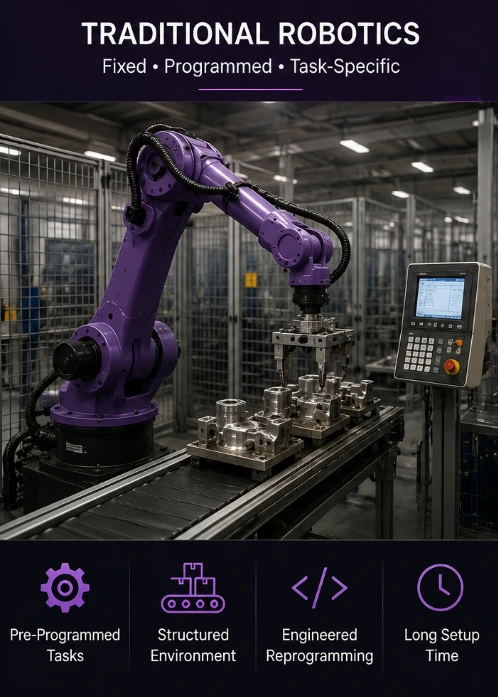
Traditional robotics works particularly well when a task and its environment are predictable.
An industrial robot can repeatedly perform the same movement with high precision when the object position, tools, lighting and workspace remain controlled. This makes traditional automation highly effective for applications such as repetitive manufacturing and material handling.
The challenge appears when conditions change.
A different object may arrive, the workspace may be rearranged, or a task may require a decision that was not included in the original programming. In these situations, a fixed script may require additional engineering before the robot can handle the change.
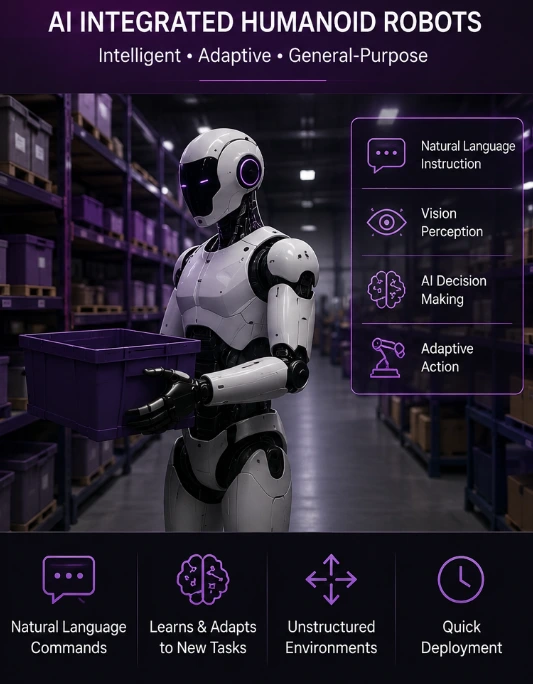
AI-integrated humanoid robots take a different approach. They are designed to use learned models to interpret their surroundings and respond to instructions rather than depending entirely on individually programmed movements.
| Dimension | Traditional Robotics | AI-Integrated Humanoid Robots |
|---|---|---|
| Control | Pre-programmed movements | AI-generated actions |
| Environment | Usually structured | Intended to handle greater variability |
| Instructions | Task-specific programming | Can use natural-language instructions |
| Adaptability | Limited outside programmed conditions | Designed to generalize learned behaviors |
| Applications | Repetitive, predictable processes | Picking, sorting, inspection and other variable tasks |
| Development | Often requires task-specific engineering | Can build on pre-trained models |
This does not mean AI-integrated robots automatically outperform conventional robots. For highly repetitive and controlled tasks, traditional automation can still be the more practical solution.
How Do AI-Integrated Humanoid Robots Work?
The main difference is the software connecting perception, language and physical action.
Vision-Language-Action Models
Vision-Language-Action models, commonly called VLA models, connect what a robot sees with what it has been instructed to do and the physical actions required to complete the task.
For example, an operator could give an instruction such as “pick up the blue tote and place it on the cart.” The system can use camera information and the instruction to determine an appropriate sequence of actions.
This approach reduces the need to manually specify every individual movement.
However, a VLA model does not make a robot universally capable. Performance still depends on the model, training data, robot hardware, environment and task.
Robotics Foundation Models
Robotics foundation models provide a general starting point for multiple robotic tasks or platforms.
Instead of developing a completely separate model for every task, developers can adapt an existing model to a particular robot or application. NVIDIA Isaac GR00T and Figure AI’s Helix are examples of the broader movement toward foundation models for robotics.
This approach is intended to make robot training and deployment more flexible, although the amount of adaptation required can vary considerably between tasks.
Reasoning and Movement
Some AI-integrated robotic systems separate higher-level decision-making from fast physical control.
A reasoning component can determine what the robot should do, while a faster control system handles the detailed movements needed to carry out that decision.
This is useful because planning and physical movement have different timing requirements. A robot may need to reason about a task relatively slowly while controlling its limbs much more quickly.
What Is Physical AI?
Physical AI, also known as embodied AI, refers to artificial intelligence that can perceive and act in the physical world.
A conventional AI system can describe how to perform a task. A physical AI system has to interact with its environment to actually perform it.
Humanoid robots are one possible platform for physical AI because their human-like form is designed to work in environments created for people.
Doors, stairs, shelves, tools and other everyday infrastructure can potentially be used without completely redesigning the environment around the robot.
The physical form alone, however, does not make a humanoid robot useful. Reliable perception, manipulation, control, safety and economics are equally important.
How Do Humanoid Robots Learn New Tasks?
AI-integrated humanoids can use several approaches to learn physical tasks.
Imitation Learning and Teleoperation
With imitation learning, a robot learns from demonstrations of a task. A human may physically guide the robot or control it remotely through teleoperation.
The system can then learn patterns from those demonstrations and attempt to reproduce the behavior independently.
This approach can be useful when manually programming every movement would be too time-consuming.
Sim-to-Real Training
Another approach is to train or test robotic behavior in a physics simulation before transferring it to a physical robot.
Simulation allows developers to experiment with tasks without repeatedly putting physical hardware through every training attempt. It can also help identify potential problems earlier in the development process.
Simulation is not a complete substitute for real-world testing. Physical environments contain variables that are difficult to reproduce perfectly, including object properties, friction, lighting, people and unexpected obstacles.
Are AI-Integrated Humanoid Robots Economically Viable?
The economics of humanoid robotics are still developing.
Robot prices vary by platform, configuration, capabilities and purchasing model. Market forecasts also differ between research organizations and can change as the industry develops.
For that reason, a business should avoid evaluating humanoid robotics based only on the advertised purchase price or a general market forecast.
The more useful question is:
What does it cost to perform a specific task with a robot compared with the current process?
A realistic evaluation should consider:
- Hardware and integration costs
- Maintenance
- Downtime
- Human supervision
- Training
- Safety requirements
- Utilization
- Existing labor and operating costs
- Expected task performance
A robot that is inexpensive to purchase may not be economical if it requires extensive integration or frequent human intervention. Likewise, a more expensive system could make sense if it reliably performs a valuable task at sufficient utilization.
The economics therefore need to be evaluated at the task and deployment level.
Where Could Humanoid Robots Be Useful?
Humanoid robots may be particularly interesting for tasks that are repetitive but take place in environments with some variation.
Potential applications include:
- Warehouse picking and material handling
- Tote and bin sorting
- Basic inspection tasks
- Repetitive movement between workstations
- Operations where existing facilities are designed primarily for human workers
These are potential application areas rather than guarantees of current capability. Each task needs to be tested under its actual operating conditions.
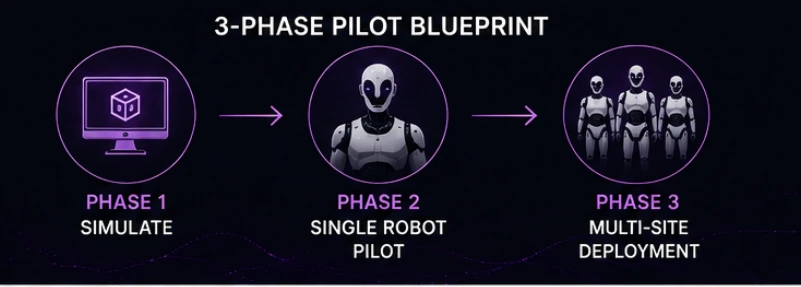
A Practical Three-Phase Pilot Strategy
Organizations considering humanoid robotics do not necessarily need to begin with a large fleet.
A staged pilot can provide a clearer picture of whether the technology is appropriate for a particular operation.
Phase 1: Simulate and Fine-Tune
Begin with one clearly defined task.
Where appropriate, use simulation to test the task and identify potential failure modes before deploying physical hardware.
For example, a warehouse could model a defined movement involving a particular group of products.
The purpose is not to prove that simulation perfectly represents the real environment. It is to reduce unnecessary physical experimentation and improve the initial training process.
Phase 2: Test One Robot on One Task
The next step is a narrow physical pilot.
Choose a task that can be measured clearly, such as moving containers between two defined locations or completing a specific inspection routine.
Track metrics such as:
- Completion rate
- Error rate
- Throughput
- Downtime
- Human intervention
- Maintenance requirements
- Safety performance
Keeping the first deployment narrow makes it easier to determine whether the robot is actually improving the process.
Phase 3: Expand After the Pilot Works
If the first pilot meets its technical, operational and safety requirements, the organization can consider additional tasks or locations.
This is where foundation-model-based robotics could become especially valuable. If a trained model and integration process can transfer effectively, future deployments may require less development than the initial one.
That benefit should be measured rather than assumed.
What Should Businesses Measure?
A successful demonstration is not necessarily a successful automation project.
Before starting a pilot, define what success means.
Technical performance
Can the robot complete the task reliably under real operating conditions?
Operational performance
Does it improve throughput, reduce repetitive manual work or make the process more consistent?
Financial performance
Does the total cost of deployment make sense compared with the current workflow?
Safety
Can the robot operate safely around workers, equipment and other moving objects?
Scalability
Can the same model, tools and integration approach support another task or location?
These measurements provide a much stronger basis for investment decisions than a demonstration video or a single successful test.
The Biggest Challenge: Generalization
One of the most important promises of AI-integrated humanoid robots is their ability to generalize.
A robot may successfully perform a task in one environment without being equally reliable when the object, lighting, layout or instructions change.
That is why businesses should distinguish between three different levels of capability:
- The robot can demonstrate a task.
- The robot can repeat the task reliably.
- The robot can generalize the capability to new situations.
The third level is particularly important for general-purpose robotics, and it is also one of the areas that requires careful real-world evaluation.
Will Humanoid Robots Replace Human Workers?
It is too early to treat workforce replacement as an automatic outcome of humanoid robotics.
Early deployments can instead focus on repetitive, physically demanding or difficult-to-staff tasks while people continue handling supervision, exceptions and work requiring judgment.
This approach also gives organizations an opportunity to understand where robots perform well and where human involvement remains necessary.
The long-term impact on work will depend on technical capabilities, economics, safety requirements and how organizations choose to deploy the technology.
What Does the Future of Humanoid Robotics Look Like?
The development of humanoid robotics is increasingly becoming a combination of hardware and AI.
Robots need capable mechanical systems, sensors, actuators and power systems. At the same time, they need software that can interpret their surroundings, understand instructions and translate decisions into physical actions.
VLA models, robotics foundation models, imitation learning and simulation are helping researchers and companies explore this direction.
That does not mean humanoid robots are ready to replace every existing automation system. Conventional robotics remains highly effective when tasks are predictable and tightly controlled. AI-integrated humanoids face their own challenges, including reliability, safety, cost and generalization.
For businesses, the most practical approach is gradual: choose one measurable use case, test it carefully, evaluate the results and expand only when the evidence supports the next step.
Humanoid Robotics Questions
What are AI-integrated humanoid robots?
AI-integrated humanoid robots combine humanoid hardware with AI models that help them perceive their environment, understand instructions and generate physical actions.
What is a Vision-Language-Action model?
A Vision-Language-Action model connects visual information and language instructions with physical actions performed by a robot.
How are AI humanoids different from traditional robots?
Traditional robots often depend heavily on predefined programs, while AI-integrated systems aim to learn and generalize behaviors across different tasks and environments.
What is sim-to-real training?
Sim-to-real training involves developing or testing robotic behavior in a simulated environment before transferring the learned behavior to a physical robot.
Are humanoid robots ready for widespread business use?
Their suitability depends heavily on the task, environment, robot platform and required level of reliability. A focused pilot is a better way to evaluate a specific use case than assuming the technology is suitable for every operation.
How should a company start a humanoid robotics project?
Start with one clearly defined task, evaluate it through simulation where appropriate, test a single physical robot and measure technical, operational, financial and safety performance before considering wider deployment.
Conclusion
AI is changing humanoid robotics by making robots less dependent on fixed scripts and more capable of interpreting instructions and adapting learned behaviors to physical tasks.
The technology is promising, but successful deployment depends on more than a robot’s ability to walk or complete a demonstration. Reliability, safety, cost and generalization all need to be tested in the real environment.
For organizations exploring physical AI, a small, measurable pilot is the most practical starting point. The goal should not be to deploy the most robots first, but to identify where AI-integrated humanoids can create genuine operational value.
References
- Mordor Intelligence, “Humanoids Market Size, Forecast Report (2026 to 2031),” market sizing and CAGR estimates: mordorintelligence.com/industry-reports/humanoids-market
- MarketsandMarkets, “Humanoid Robot Market worth $50.27 billion by 2035”: finance.yahoo.com, MarketsandMarkets report
- Fortune Business Insights, “Humanoid Robot Market Size, Share and Growth Report (2034)”: fortunebusinessinsights.com/humanoid-robots-market-110188
- The Robot Report, “Vision-language-action models are the next leap in autonomous robotics”: therobotreport.com, VLA models feature
- NVIDIA, “Develop Humanoid Robot Policies End-to-End with NVIDIA Isaac GR00T”: developer.nvidia.com/blog, Isaac GR00T
- RoboZaps, “Humanoid Production Economics (2026),” unit pricing and payback-period figures: blog.robozaps.com/b/economics-of-humanoid-robot-production